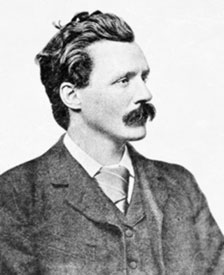
None of Gissing’s early novels made much money, or earned him much recognition, and all came from his experiences of the lower walks of life in contemporary London. In the 1870s, he fell in love with a prostitute, and married her, although their life together was disastrous. She drank and intermittently returned to prostitution, and he eventually paid her to live apart from him, where she died in utter squalor, from drink, and probably venereal disease. The Unclassed is positively cheery in comparison to this (although, when this was written, Gissing’s wife was very much alive) but it still it makes for sobering reading, even when sitting on a warm hearth-rug.
The tale opens in a little school. Three small girls are introduced to the reader, and one small act of anger perhaps starts the downwards spiral of tragedy. In innocent fury, Ida throws her slate at Harriet, who has made malicious (albeit true) comments about Ida’s mother being a streetwalker. Maud is a sweet, young, onlooker, who is on Ida’s side. As a result, Ida is dismissed from school; her mother soon dies, and she has little choice but to turn to prostitution herself. Harriet, a naturally weak child, is weakened still further by the blow, and emotionally blackmails her handsome, and kind cousin, Julian, into marrying her, where she proceeds to crush the joy of life out of him. Maud is browbeaten into religious submission by her stern aunt, and so lives most of her life in a state of nervous repression. Years later, when all three are roughly eighteen, comes a man, Osmond Waymark, friend of Julian, who falls into a state of confusion. He loves both Maud for her purity, and Ida for her vitality, and agonises over the differences of love and desire, of whether he can love two women at once, and due to the unconventional nature of his interaction with them, who he is bound to love best. He sees and believes he loves Maud first, and begs to be allowed to write to her when she goes away. He meets Ida on the streets shortly afterwards, and their friendship grows in Maud’s absence, although any tentative advances he makes are coolly rebuffed. Later on due to the machinations of the deranged Harriet, the now-loving Ida is absent, and the less reticent Maud present, and Waymark’s affections rapidly veer towards the latter. Absence makes the heart grown fonder? Not in Waymark’s case; he seems a strong advocate for the “out of sight, out of mind” school of thought.
Underlying the personal tribulations of the childhood friends, Ida and Maud (who, ironically, never meet each other in adulthood, or find out that the other is even in Waymark’s life, let alone the potential object of his affections) is the dingy, grimy backdrop of London. Although the main characters are a step up from the lowest classes – Waymark begins as a teacher, Maud a governess - the desperate poor are all too noticeable. There are several disturbing and grotesque images that are, quite frankly, unpleasant to read. The poor are depicted as animals, base and gross. Gissing has a way with words, however, so as not to show any perverse enjoyment in his depictions of wretchedness. He matter-of-factly describes a mother with smallpox, lying comatose on what was “for want of another name, was probably called a bed” while her infant children are sitting on the floor, playing with a dead kitten, “their only toy.” This pitiful image of life and death and deathliness all trapped in a room together is powerful and all-pervading; the kindly man who is inspecting them catches the disease himself, and later dies.
This is hardly a cheerful note on which to end a pre-Christmas post. However, rest assured that the ending is probably not quite as dire as you may be imagining. There is disease, (naturally; this is a Victorian novel), and there is death (obviously; this is a Gissing novel), but, unusually, at the end, there is a tremor of hope, even, dare I say, joy…? Which is a welcome relief. So, settle down by the fire, or radiator, perhaps (or, for those of you lucky enough to be abroad, smugly sit in the sunshine) and let the gentle, carefully-placed words of Gissing transport you to the slums of London. Who knows, you may even learn something about human compassion and love, which is, after all, sort of the message of Christmas… Happy reading!



No comments:
Post a Comment