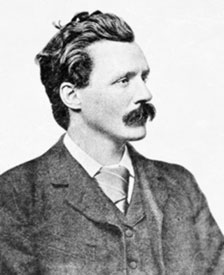
It’s nearing Christmas. The log fire is roaring away, sending brisk sparks up the chimney; snow is falling from the dove-grey sky; and I am sure there are mince pies somewhere if I could be bothered to get up and look. The perfect time and place, perhaps, for a longish Victorian novel. A festive Dickens, perhaps? That would be much too appropriate and cheering. I turned instead to my self-written dissertation reading list and decided to read a work of one of the most depressing Victorian novelists, the solemn-faced, little heard-of George Gissing. Granted, The Unclassed is not the most grim of his many grim novels – he even roams into the Dickensian humour, sometimes (which is more than can be said for The Nether World, a depressingly-titled story of the poorest of the poor in London), but nevertheless, it is a saddening, and sometimes frustrating, novel to read.
None of Gissing’s early novels made much money, or earned him much recognition, and all came from his experiences of the lower walks of life in contemporary London. In the 1870s, he fell in love with a prostitute, and married her, although their life together was disastrous. She drank and intermittently returned to prostitution, and he eventually paid her to live apart from him, where she died in utter squalor, from drink, and probably venereal disease. The Unclassed is positively cheery in comparison to this (although, when this was written, Gissing’s wife was very much alive) but it still it makes for sobering reading, even when sitting on a warm hearth-rug.
The tale opens in a little school. Three small girls are introduced to the reader, and one small act of anger perhaps starts the downwards spiral of tragedy. In innocent fury, Ida throws her slate at Harriet, who has made malicious (albeit true) comments about Ida’s mother being a streetwalker. Maud is a sweet, young, onlooker, who is on Ida’s side. As a result, Ida is dismissed from school; her mother soon dies, and she has little choice but to turn to prostitution herself. Harriet, a naturally weak child, is weakened still further by the blow, and emotionally blackmails her handsome, and kind cousin, Julian, into marrying her, where she proceeds to crush the joy of life out of him. Maud is browbeaten into religious submission by her stern aunt, and so lives most of her life in a state of nervous repression. Years later, when all three are roughly eighteen, comes a man, Osmond Waymark, friend of Julian, who falls into a state of confusion. He loves both Maud for her purity, and Ida for her vitality, and agonises over the differences of love and desire, of whether he can love two women at once, and due to the unconventional nature of his interaction with them, who he is bound to love best. He sees and believes he loves Maud first, and begs to be allowed to write to her when she goes away. He meets Ida on the streets shortly afterwards, and their friendship grows in Maud’s absence, although any tentative advances he makes are coolly rebuffed. Later on due to the machinations of the deranged Harriet, the now-loving Ida is absent, and the less reticent Maud present, and Waymark’s affections rapidly veer towards the latter. Absence makes the heart grown fonder? Not in Waymark’s case; he seems a strong advocate for the “out of sight, out of mind” school of thought.
Underlying the personal tribulations of the childhood friends, Ida and Maud (who, ironically, never meet each other in adulthood, or find out that the other is even in Waymark’s life, let alone the potential object of his affections) is the dingy, grimy backdrop of London. Although the main characters are a step up from the lowest classes – Waymark begins as a teacher, Maud a governess - the desperate poor are all too noticeable. There are several disturbing and grotesque images that are, quite frankly, unpleasant to read. The poor are depicted as animals, base and gross. Gissing has a way with words, however, so as not to show any perverse enjoyment in his depictions of wretchedness. He matter-of-factly describes a mother with smallpox, lying comatose on what was “for want of another name, was probably called a bed” while her infant children are sitting on the floor, playing with a dead kitten, “their only toy.” This pitiful image of life and death and deathliness all trapped in a room together is powerful and all-pervading; the kindly man who is inspecting them catches the disease himself, and later dies.
This is hardly a cheerful note on which to end a pre-Christmas post. However, rest assured that the ending is probably not quite as dire as you may be imagining. There is disease, (naturally; this is a Victorian novel), and there is death (obviously; this is a Gissing novel), but, unusually, at the end, there is a tremor of hope, even, dare I say, joy…? Which is a welcome relief. So, settle down by the fire, or radiator, perhaps (or, for those of you lucky enough to be abroad, smugly sit in the sunshine) and let the gentle, carefully-placed words of Gissing transport you to the slums of London. Who knows, you may even learn something about human compassion and love, which is, after all, sort of the message of Christmas… Happy reading!
Monday, 20 December 2010
Monday, 15 November 2010
Persuasion
I read the majority of Persuasion the day after a ball. Despite the lack of ballroom action in this particular novel in comparison to Austen’s other works, to read this Regency tale with last night’s merriment in mind seemed oddly fitting. Alright, there was a distinct lack of handsome Byronic heroes, and not a country reel to be heard, but there was plenty of wine and spirited conversation, (ranging from small-talk to salacious gossip), not to mention elegant dresses and a sharp dinner jacket or two. Slightly less Austen-esque were the unlimited candyfloss and shisha tent entertainments, but nevertheless, a ball is a ball, and, whether thrown now or two hundred years ago, excellent for awakening the imagination.
I always see Persuasion as Austen’s saddest novel. Some critics harp on about how it was her last novel and we can see her regret and woes showing through, but actually, it wasn’t at all – she’d begun writing another novel before she died, one that is quite lighthearted. However, that is not to undermine the poignant themes of regret and loss coursing through the story. It’s probably the old-fashioned sentimentalist lurking inside my soul, but I like to think that Austen looked at her own lifetime and missed opportunities, and wrote about the highly unlikely but overwhelming change that a second chance might bring about – perhaps sadly, perhaps wistfully, but always with the utmost grace and eloquence.
Persuasion is less about the thrill of a new love, as her other novels often are, but about the reminiscences and nostalgia surrounding the old. Most people will know the plot, but I will outline it anyway. Anne Elliot, at nineteen years old, meets a Frederick Wentworth. They are perfectly matched, entirely in love, and intend to marry. Indeed, they would have, had it not have been for the interference of Lady Russell, Anne’s godmother, a distinguished woman who is rather too pragmatic for her own good. Lady Russell sees his inferior rank and Anne’s young age as a poor recipe for happiness, and so persuades Anne to break off the engagement. He goes away to sea and makes his fortune; Anne is left behind. Eight years pass, and Anne has never fully recovered; her feelings remain the same, but she has become faded and sad. Circumstances arise (concerning her amusingly vain father and elder sister’s extravagant spending of money on trivialities) which lead to Wentworth’s (now a rich Captain, of course) sister and her husband renting Anne’s family house. Their paths cross, and Anne is in agony as she watches Wentworth, who is still angry with her, initiate flirtations with others. She, in turn receives attention from suitors, and the reader has to watch two soulmates, for want of a better word, drift even further apart. What makes it so heartrending for the reader is that we know that had they married eight years previously, they would have lived in perfect happiness. Even in the face of the inevitable Austen happy ending (I swore I would never spoil an ending for a reader, but, it being a Jane novel, it is fairly obvious that they end up together), it seems like a horrible waste. Eight years apart, which leads to little but his acquisition of money, without which they would have been perfectly happy, anyway.
A word or two must be said about her language. Less a playful social satire than her other works, her turn of phrase for conveying humour or that famous irony is nevertheless utterly exquisite. Yet what I truly adore is the way that the reader is let wholeheartedly into Anne’s mind through what is called ‘free indirect discourse’ – a style of narration that admits all the intimacy of a first-person narrative, without the egoistical ‘I’. We see Anne’s every blush, witness her deepest thoughts and sense her quickening heartbeat, as well as feel her sorrows, all the while maintaining a distance so we can judge characters for ourselves. Austen cleverly gives us as close a sense of Anne’s experience as possible, without straying into the first person. One moment that is extremely effective is when Anne sees Captain Wentworth for the first time in eight years. We see it through Anne’s eyes, briefly, as “her eye half met Captain Wentworth’s,” then as she hastily looks down, we hear his progress around the room as opposed to see it. In this ingenious way, Austen makes their meeting as awkwardly anticlimactic as it might be in real life, and pinpoints to perfection Anne’s confusion and distress.
Ah, I love Jane Austen. I love this novel; I won’t hear a word against it. Yes, I am one of those mad people who see Jane as a kind of friend and guiding influence. Her writing (not just her novels, her letters, too) make me wish I was as subtly and sharply witty as her, and not only do I identify with more than one of her heroines, but I also blame her for my extremely high standards in men… My love for Jane is blind and absolute, and therefore, do not expect a word of criticism from me. I am afraid you will have to read Persuasion yourself, then tell me of your misgivings, so I can argue against them, with as much wit and charm as I can muster.
Friday, 1 October 2010
The House of Mirth
Yet another trip abroad ensured that a wonderful book remained firmly in my suitcase, sadly only partly read. The occasion this time was a spontaneous weekend trip to Dublin to see a friend; an opportunity to appreciate the divine Georgian architecture, cram into the lively bars, and spend as little money as possible, as we are, of course, poor students. Resuming the novel, however, at the airport, before my flight home, had the power to utterly rejuvenate my rather exhausted spirits, and I remained enthralled by The House of Mirth and its vivacious, yet deliciously tragic heroine for the duration of the flight and the train home.Edith Wharton is a name that resonates faintly in my knowledge as someone I have heard of, but never read. Both The House of Mirth and The Age of Innocence are on the reading list for my ‘American Fiction’ module - the only reason I reached for this one first was because of its cover – an enigmatic and captivating woman in an extravagant dress. In this instance, this is a case of judging a book by its cover, as it is, in short, what the novel is about. Lily Bart is the darling of New York society – graceful, unreservedly charming and very beautiful indeed. Intriguingly, Wharton ensures the reader sees very clearly the artifice behind her allure – yet this does nothing to dispel the reader’s liking for Lily. She is, after all, poor, compared to her circle of friends, and has to work every attraction she has to avoid being cast out. When the reader is introduced to her, she is in the process of tempting an uninteresting yet incredibly rich man to marry her. Lily is unashamedly drawn to money – to her, it is the most important thing in the world. She believes it keeps her happy and safe, although this belief is strongly tested throughout the novel, and eventually leads to her downfall. No matter how unfortunate her fate, Wharton draws the reader on as they wonder whether Lily will ever find the true key to happiness.
Despite the apparent seriousness of plot, The House of Mirth is a very readable book. At once a tantalising glimpse of the gilded age of American society, and a wry and intense satire on the triviality and shallowness of the people involved, its casual language is a joy to read. I suppose Wharton is almost Austenesque in her subtle social commentary – gently mocking the officious elderly aunts of the world, the desperate social climbers and the maidish spinsters. There is a different dimension, however, to pure ridicule; one gains the sense that it is the façade that Wharton despises so, not the people themselves. The characters’ motives become clear and the polished circle of New Yorkers seems instead to be in a Darwinian struggle for survival, one that drags people under while propelling others to the top.
Running throughout the novel, which is primarily a tale of Lily’s efforts to keep up appearances despite increasing debt, is a love story. Lawrence Selden is the one man who can see through Lily’s carefully constructed airs (though sometimes misguidedly), and love her nevertheless. The reader wills them together, and Wharton teases by drawing them close, and parting them time and time again. I shall leave it a mystery as to whether Lily can ever overcome the thrall of money and find her way to love, and I hope this inspires you to take up the novel and begin it yourself!
Overall, a topping novel. It makes me long to experience the thrill of New York before the turn of the century, and it makes me fear it as well. The two-faced heiresses and brusque men repulse me just as much as the whirlwind of parties and lighthearted conversation attracts. What makes this novel more than just a biting social commentary is the personal and poignant story of Lily – she charms the reader just as she charms many of the male characters themselves – though whether her story ends happily I shall leave to the reader to discover.
Tuesday, 21 September 2010
The End of the Affair
I read The End of the Affair in Hong Kong, so I’m afraid I wasn’t quite as focused as I should have been. Frequent pauses to gaze at the staggering view out of my friend’s balcony ensured progress was slow. Yet something about the humidity, and the serenity of the world outside - as ships breezed past the widening bay and the surrounding islands were shrouded in mist - threw this very English novel into sharp relief. The introspective and bitterly self-analytical nature of the narrator, and the passion of which he writes (one that could equally be of hatred or love) seemed to jump off the page into the sultry air, and smack me on the face.Set in 1940, the intensity of the relationship between the narrator, Maurice Bendrix and Sarah effortless manages to eclipse the ferocious war in a way that hugely interests me. The Blitz was, of course, raging through London at the time, and whilst it plays in important role in the story, it is by no means the main character. It cemented my recent epiphany, realised after reading The Slaves of Solitude, that novels that spring from the ashes of war are not necessarily centred around the war itself. Indeed, at one point Bendrix notes carelessly, “I suppose Germany by this time had invaded the Low Countries…” showing perfectly the all-consuming nature of his affair with Sarah.
Despite Graham Greene being an extremely well-known and prolific author, I have read embarrassingly little of his work – not even Brighton Rock (although my mother did make me read Doctor Fischer of Geneva when I was fairly young – I think I am still traumatised). The End of the Affair is one of those novels that one is unsure as to whether one likes. There is a delicious twist to the story that is immensely satisfying, and yet the heavy debates on Catholicism, as well as the fact the narrator is not hugely likeable deadened my enjoyment somewhat. The knowledge that it is loosely autobiographical, however, piqued my interest. Boldly dedicated to ‘C’, this novel parallels Greene’s own affair with Lady Catherine Watson. As anyone with a remote interest in literature should know, it is a grave mistake to ever assume that the narrator is quite literally the voice of the author. However, it is interesting to note that the main character, Bendrix is a novelist, and comments clearly, and often coldly, on the process of writing. I wondered how similar Greene is to Bendrix, and whether he would really want to expose his soul on the cold pages of a novel, leaving me with the conclusion that Benedrix is like Greene, but is resolutely not Greene.
I found the characters rather fascinating, if not believable. The most likeable character has to be Henry, Sarah’s husband. He is kind and essentially a good man, yet he is dull and rather pathetic. He fulfills the clichéd position of the oblivious husband, and indeed, it seems to be his only role. I also found it difficult to wholly emphasise with Sarah. She is a fully-fledged character yet I found there was a curious two-dimensional quality to her in Bendrix’s narration. It could be that this is an artistic device in itself, she is, after all, full of vitality in her diary entries later on, as she agonises over her faith. Perhaps Greene deliberately ensures that Bendrix’s writings of her are inadequate and flat, reflecting the futility of the writing process, as one can never fully capture life in words. Or maybe he is commenting on the fact no one can every really know another person, something that is echoed in the plotline itself. Either way, it ensures the novel itself, while an excellent and engaging story, and quite amusing at times – seems very much to be written by a writer, if that makes any sense at all.
I am aware that this is not exactly a glowing (or coherent) review. Please do not misunderstand me: I genuinely admire this novel. The passion Bendrix feels for Sarah is tangible in every line, and the questions about life and God that are wrestled with by many of the characters are thought-provoking. However, it is also the kind of novel one needs frequent rests from; rests made all the more pressing by the presence of sunlight dancing on the waves outside the window.
Sunday, 5 September 2010
The Slaves of Solitude
My stepfather, having done the unenviable task of reading all my literary reviews in one go (everyone else in my immediate family having managed to keep up to date, although possibly out of politeness rather than desire), has pointed out that I talk rather a lot about how long it’s taken me to read a particular novel. I would like to say, in my defence, that the speed or slowness with which I peruse a work of literature is often a good indicator as to how much I enjoyed it – but nevertheless, I will cease this somewhat unliterary gauge of excellence and try and rely solely on the content.Patrick Hamilton is one of those authors that contemporary authors and clever people bemoan as being forgotten or underappreciated. I don’t know if I’m being very uncultured in saying that I hadn’t heard of him until a few months back, but he’s not exactly a household name. But, as Doris Lessing furiously asserts in the introduction in my copy, he deserves to be. I have come to agree wholeheartedly. The Slaves of Solitude is a bleak but unabashedly humorous (in a wry sort of way) novel, written between 1943 and 1946, and set in the war years. Although there is no description of battlefield action, and no bombs are dropped in the duration of the novel, the war pervades every page and seems to taint the action and characters with lethargy and bitterness.
The novel takes place in the small fictional town of Thames Lockdon, in a boarding house, The Rosamund Tea Rooms. The main character is Miss Roach, a pleasant, ordinary sort of woman, approaching middle age. Also living at the Tea Rooms are a couple of elderly women, the abrasive and bullying Mr. Thwaites, and a more ‘common’ man, who spends very little time there. Everything seems bland and dull; one has the impression that there are identical boarding houses, with identical occupants all over the country, all with the same stagnant atmosphere. Hamilton manages to convey the oppressive atmosphere beautifully, representing perfectly, with an acute but never cruel eye, the pettiness and banality of the characters. Things are shaken up a bit with the arrival of an American lieutenant, and further still when Miss Roach’s German friend, Vicki, moves into the boarding house, and the main storyline is wrapped around these two events.
Hamilton’s use of language is both damning of the British social pattern, and hideously amusing. I found myself laughing aloud at Mr. Thawaites’ grotesque attempts to talk eloquently – it all seemed so surreal, almost Pinteresque, yet so horribly imaginable. Similarly, Miss Roach’s indignant internal monologues seem so very real that they are both alarming and funny. The main storyline (a feud between the very English Miss Roach and the dangerously continental and loathsomely seductive Vicki) is at once ridiculous if the much more serious background of the war is taken into account, but Hamilton gives it a sense of vast importance, and deals with the fraught emotions of Miss Roach gently and sensitively.
As ever, I am reluctant to give away important plot details, so I will restrain myself. It’s odd, actually, in that there isn’t that much plot to speak of – the true beauty of this novel is that Hamilton’s genius shines through his exquisitely careful use of language, designed to be read in seriousness, yet able to evoke strange feelings of pity, amusement and disdain. His characters are crafted with the utmost care, and one sympathises deeply with Miss Roach, and wonders where the gradual crescendo of quiet events in the deathlike boarding house will take her.
Overall, therefore, an immensely satisfying read. I hope this review portrays a little of Hamilton’s extreme skill at minutely portraying human character – and that you have noted that not once have I said how long this book has taken me to finish...
What's this about?
British,
Comedy,
English,
forgotten authors,
Hamilton,
Second World War
Friday, 3 September 2010
The Fallen Blade
This has to be the most contemp-orary book I will ever write about – not only is it written by an author who is still alive and well, it hasn’t even been published yet! The Fallen Blade: Act 1 of the Assassini Trilogy by Jon Courtenay Grimwood will be available to buy in January 2011, and I assure you, it is well worth the wait. I managed to get my grubby paws on it purely because of my bloodline – the esteemed author is, in fact, my uncle. All bias aside, I am being perfectly honest when I say that I enjoyed it enormously. I wouldn’t exactly call myself a literary snob, (I have, after all, read the Twilight Saga), but, let’s just say, if I hadn’t liked this particular book, I wouldn’t have immediately texted Jon and asked whether I was legally allowed to write a review before its publication (for those of you wondering: I am.) Perhaps it was the recent overdose of Victorian depression and Romantic wimpiness, but this absorbing and energetic novel was a total shock to the system. To say I was hooked is an underestimate. To say I am eager for the next novel is also an underestimate. Despite always liking a good night’s sleep, I read this late into the night and bolted awake early (most unlike me) to resume the story.For those of you mildly disgusted by the Twilight books – full of sparkly vampires, and lovestruck werewolves – then, rest assured, this is absolutely nothing like them. Set in the dingy streets and elegant palaces of fifteenth century Venice, the city is conjured up from the pages like a mirage. Grimwood’s (how odd it is to use my own surname!) language is capable of evoking every scene with utter clarity. The filth and grime of the sewer-strewn canal paths are described as evocatively as the insincerely polite scenes at court. Acts of indescribable violence are recorded in the same manner as a sudden realisation of love. It is this level undercurrent of Grimwood’s narrative voice that binds the novel together, and that made me race through it at such an unprecedented speed.
The novel (which, I am afraid, is one of those that requires a family tree and a dramatis personae at the beginning – although if my brain could cope with this, so can yours) centres around Lady Giulietta, a young Venetian noblewoman, whose hand in marriage has been promised to a brutal foreign king, for the sake of a political allegiance. One has the impression that this kind of political power is genuinely all that matters to the members of Giulietta’s family that are orchestrating this connection, and indeed, much of the aristocracy at the time. The corruption of the court seems to trickle down the social ladder to every walk of Venetian life - there is very little trust and rather a lot of fear. The other main character (although there are several characters of importance) is Tycho – an unspeakably beautiful boy with silver-bright hair and strange eyes. He arrives in Venice with only the faintest memories and no understanding as to how he got there. His remarkable speed and reflexes attract the attention of the Duke’s chief assassin, who then attempts to recruit him to his secretive and elite group of hired murderers - the assassini. Tycho and Giulietta’s respective plotlines slide past each other, crossing and recrossing. And towering above these two protagonists is arguably the true main character: the city herself. Venice is a deceitful city with a beautiful face, behind which lies treachery and corruption. These elements combine into a deadly poison, and escalate towards the novel’s gripping conclusion.
Sorry for the complete lack of detail – I am most definitely not allowed to disclose important plot points. Still, I hope it creates some form of curiosity that will last until January. I can tell you now, that it will be an excellent book to read by the fire in the chills of winter! A quick summary: Grimwood (hah!) delivers an absolutely inspired take on assassins, werewolves and vampires - topics we’d all thought had been done to death (no pun intended). But, for me, it is the elusive Venice that draws one close, intoxicates, and withdraws – leaving the reader absolutely burning for more.
The Time Machine
After my arduous experience of The Mysteries of Udolpho, and being wearied of its archaic and crying heroine, I naturally had to recover for an afternoon. It wasn’t long, however, before I reached for the shortest book I could find on my reading list, which also happens to be the most futuristic. The Time Machine by H.G. Wells is a tiny little thing – a mere 118 pages (at least, it is in my rather 1980s-style copy), following a basic story-within-a-story layout, in which the Victorians so delighted. A discerning and pleasant young man narrates the frame of the story – we never find out his name or occupation, but we do know that every Thursday, he and a group of other men assemble for dinner and a masculine chat at the mysterious “Time Traveller’s” house. The Time Traveller begins by explaining his innovative theories on time – something at which I initially inwardly groaned, thinking I was going to drown in lengthy explanations, but really, it’s all fairly straightforward. I was going to paraphrase these ideas, but on second thoughts, decided against this - it would almost certainly put you off. Nevertheless, after this theoretical discussion, the men reconvene a week later, to find that the Time Traveller arrives an hour late to his own dinner party, bleeding, limping, haggard, exhausted and hungry. He washes, dresses, ravenously devours a plate of mutton, and then relates to his astonished friends a remarkable tale, that is to take up the next twelve chapters. He claims he has travelled forwards in time, to the year 802701 AD, where humanity has evolved (or degenerated – a popular theme with the more depressed Victorian writers) into a small, joyful, and idle race.
Without wanting to give too much away, what initially seems to be a paradise - “the Golden Age” - becomes increasingly sinister. Although it appears that amongst this new and beautiful race, there is no disease, crime or pain, it soon becomes evident that evolution has split, and branched into two strains of humankind – those who live in peace on the earth’s surface, and those who skulk and creep in the depths of the earth.
I am immediately tempted to say that I loved this novel – or novella, rather, as it really is extremely short. However, a closer inspection of my thoughts reveals a more indistinct opinion. You see, there’s not really that much in it to love. It is, in a way, a twisted version of Sir Thomas More’s Utopia, and I’ve no doubt that Wells drew inspiration from this Renaissance oeuvre. In a way similar to More, Wells presents the occurrences of this fictional alternate world as all too real. However, whereas it could be argued that More advocates the Utopians’ way of life (to a certain extent – but I won’t go into the long and boring explanation), Wells seems sickened to the very core by his bleak image of mankind’s future. He seems frightened of the direction humanity is going, both in this adventures in 802701 A.D. and when he goes even further into the future. In what was, for me, the most powerful passage in the novella, the Time Traveller narrates the earth’s death, millions and millions of years in the future, when there is barely any life on earth, and the huge, red, dying sun is obscured by blackness. It is a chilling image, and Wells’ writing seems to me to be particularly effective through the colloquial yet matter-of-fact way it is presented. It is utterly enthralling.
Well! There we have it. A short review for a short book. What interests me is whether Wells wants us to believe the Time Traveller is telling the truth or not. I’ve always been a bit of a fan of the unreliable narrator (and if you are too, two contemporary novels that spring to mind are try Alias Grace by Margaret Atwood, and the slightly more recent The Little Stranger by Sarah Waters). The knowledge that the ‘truth’ might not be strictly truthful can change your opinion of a novel in an instant, and ensure that you never read it the same way twice. The Time Traveller himself admits of his story that “most of it will sound like lying.” Indeed, several of the men witnessing his story don’t believe him at all. The young man who narrates the beginning and end of the book, however, seems decided it is true. Ambiguity, it would seem, is the order of the day. Choose what you will – either way, the novel itself is a bleak testimony to Wells’ sad and rather haunting vision of humanity.
What's this about?
Sci-Fi,
Unreliable narrators,
Utopia,
Victorian
Tuesday, 31 August 2010
The Mysteries of Udolpho

Finally. After a week of struggle, forcing my way through 632 pages of very small print, I have, at last, finished The Mysteries of Udolpho. I feel ambivalent about this novel; I think it’s fair to say that overall, I sort of enjoyed it, but the prevailing thoughts in my mind as I read this were of exasperation and irritation. Not exactly a favourable review, but let me explain.
On the back of my copy, it says that this novel, which was published in 1794, employs an “imaginative use of history, poetry, landscape and the supernatural.” This is part of the problem. Despite that, this was a huge success at the time, the author, Anne Radcliffe, earning £500 for the copyright (authors of standard circulating-library novels earned £10 or perhaps £20). Had I been born in the 1770s, and had read The Mysteries in my 20s, I am positive I would have adored it. My situation, however, remaining firmly in the twenty-first century, I have several issues with the heroine, Emily St Aubert, and her general demeanour.
Emily has been bought up by her mamma and papa very well; they have taught her the virtues of modesty and piety and general adorableness. She has been well-educated, and has had an idyllic childhood, surrounded by people who love her. As it tells me this on the back of my book, so I have no scruples in telling you this, her mother dies fairly early on, so Emily and her father go on a little holiday in the mountains to distract themselves from their woe. They don’t do a very good job, and here comes my main complaint – they cry all the time. Not just from sorrow, and not just because of the mothers’ death. The characters cry when they see beautiful scenery. They cry when they reflect on how lucky they are. They cry when they reflect on how unlucky they are. They cry when they fall in love. They cry when they are separated. They cry when they are reunited. They cry when they are happy. They cry when they are frightened. All the men cry, or if they are trying to be a bit more masculine, sigh sorrowfully. Emily, in particular, cries the most. And when she is not crying, she is fainting. It is this insipidness of character that surprises me so. Perhaps I am used to the more feisty Victorian woman – even the most “Angel in the House” characters tend to display some sort of nerve. Emily shows little courage, and little strength. The smallest shock renders her unable to speak. And despite (or perhaps, because of) her feebleness, virtually every man she encounters falls in love with her (or, in the case of the more disreputable men, want to have their wicked way with her). What kind of heroine is that?
But it isn’t just Radcliffe’s way of writing that makes Emily so colourless– Annette, Emily’s maid when she is imprisoned in the deliciously Gothic and unsettling Castle of Udolpho – is talkative and likeable. She actually has a believable character – easily frightened and superstitious, slightly silly and very loving and affectionate. Emily seems a rather two-dimensional image of what a woman ought to be, while Annette, who, in comparison, is a minor character, brims with warmth.
The reason that this took me so long to read was its pace. The first half of the novel is fairly slow – that took me at least three days to read. The second half I managed in a day and a half. Radcliffe’s use of “poetry and landscape” slows the plot down so very much, I wanted to weep. While this was possibly quite thrilling to contemporary readers, her rapturous descriptions of the Pyrenees (often accompanied by Emily snivelling with joy), that quite literally go on for pages, moved me very little. Similarly, the poems that Emily often amuses herself with composing whilst sitting, picturesquely on her own, hold no fascination for me. Titled with cutesy names such as “The Glow-Worm” “The Pilgrim” “The Sea-Nymph”, the lines are dully sentimental and make me want to hit my head against a wall. However, once Emily is effectively a prisoner, things start looking up. Yes, she still cries, but at least with vaguely good reason. Radcliffe really manages to create a sinister mood of suspense that pervades Udolpho and its gloomy corridors. The famous and dreaded “black veil” in a locked-up room (the very one that is so parodied in Jane Austen’s Northanger Abbey) hides something so horrific that Emily faints (obviously) and cannot bring herself to mention again. This mystery, along with all the other supernatural happenings, are all explained satisfactorily in a way that I applaud. Unlike other Gothic authors, Radcliffe does not allow a ghost to be a ghost; an all too terrestrial explanation is available, sometimes in most unexpected and exciting ways.
The excitement really kicks off, however, very close to the end, when Radcliffe seems to get to grips with the art of the cliffhanger. She starts following different plotlines to great effect, and more than once I reached the end of a gripping chapter, to turn eagerly to the next, and find her teasingly serene words describing an event far away from the one I wanted to read about. As with many of the novels of this period, the overall ending is a rounded off, satisfactory one. All mysteries explained, all obstacles overcome. Tears all around.
Something that interested me was the rather trite moral Radcliffe felt obliged to add at the end. “Though the vicious can sometimes pour affliction on the good”, she writes, “their power is transient and their punishment certain. …Innocence, though oppressed by injustice, shall, supported by patience, finally triumph over misfortune!” Perhaps in her Gothic world of tyrannous Counts, kindly nuns, wilting young ladies, valiant chevaliers, dastardly banditti and faithful servants, this is true. Sadly, in our world, it is not.
I realise that this article is fairly condemning of what is, after all, a magnificent piece of literature. I am perfectly aware that I have become ensnared in minute details that, to another reader, might go unnoticed. It is considered one of the greats of Gothic fiction, and so I urge the gentle reader to attempt it. My only piece of advice : do not be put off by the crying and the scenery. It gets better.
Saturday, 21 August 2010
The Private Memoirs and Confessions of a Justified Sinner

This little book was written some time before Victorian sensation-alism (a favourite genre of mine) became popular. However, being a sort-of example of a Gothic novel, it seems fair to say that this is a precursor to the kind of fiction that would so shock and excite readers decades later. Written in 1824, The Private Memoirs and Confessions of a Justified Sinner is a relatively short work, written by a Scottish shepherd, James Hogg. It was not very well received. It was called “uncouth and unpleasant” by the British Critic; “extraordinary trash” by the Quarterly Theological Review; and the Westminster Review thought Hogg had been “uselessly and disgustingly abusing his imagination” in writing this novel. Alright, it’s not the most joyful of books, but I don’t think it deserves such heavy-handed criticism as that.
It is written by two narrators; an ‘editor’, who opens and closes the novel, and the ‘justified sinner’ himself, Robert Wringhim. The editor tells the story of a jolly Laird and his ludicrously pious wife (a strict Calvinist) who eventually live separately because of their inherent differences. She has two sons – one is athletic and handsome, and is brought up by the Laird, the other, Robert, is doubted by the Laird to be his son and is so brought up by the mother and a preacher, becoming, in turn, a strict Calvinist. I have read that this is not a strictly truthful portrayal of Calvinism, but nevertheless: a brief outlining of this division of Christianity. Calvinists believed that they were chosen by God to spend eternity in Heaven. This great list was already written, and absolutely final – you couldn’t earn a place there, no matter how Christian you were, you were simply chosen as one of the elect. What Hogg exploits here is the notion that if you could not act in a way to promote yourself onto the list, then surely no one could act badly enough to be thrown off it. This attitude was so outrageous that Hogg initially had his novel to be published anonymously, for fear of retribution from High Calvinists.
To avoid entering into lengthy explanations of plot – and ruining any potential plot twists – I shall summarise in as few words as I can bear, in order to whet the appetite, so to speak! The young Robert Wringhim, burdened with a jealousy of his handsome brother, meets a mysterious stranger, called Gil-Martin, who talks most exquisitely about God. They enter into a friendship that initially, to Robert, seems to be about the glorification and discussion of their holy Father, but soon brings him to mischief, and murder. While the reader easily recognises this character to be Satan, Wringhim is so drawn in by his dazzling arguments that the sins he’s committing are justifiable and right, that he doesn’t realise how he is truly acting. There is an extremely sinister side to his character when Robert begins to have no recollection of the crimes the people around him accuse him of having done. Hogg manages all these suggestions so well that the reader might even have a suspicion as to whether Gil-Martin exists at all. It is not made entirely clear – it is up to you to decide.
So. It’s not exactly a walk in the park, but it is certainly an interesting novel to read. There are sections of fairly heavy-going religious discourse, but I suppose it is only to be expected in a book centred on Calvinism. Some bits are fairly humourous, which offers light relief, but for me, it’s worth reading purely for the portrayal of Wringhim’s escalating despair and panic as he realises that he is no longer in control of his actions. Not bad for a Scottish shepherd.
Tuesday, 17 August 2010
Lady Audley's Secret

Once again, I have eschewed the more modern books in my alarmingly large “to be read” pile, for one of my favourite genres - Victorian sensationalism. Lady Audley’s Secret, by Mary E. Braddon, a consistently successful and popular writer in the nineteenth century (although she has fallen now into relative obscurity), was written notoriously quickly - the last volume in less than a fortnight. The speed at which it was penned seems to shine through the words, not through carelessness, but through the spark and wit and sharpness of the developing plot.
As much as I adore Victorian writing, I cannot deny that some works can have tedious sections, to say the least, and it becomes something of an effort to carry on reading. One needs frequent breaks to gaze out of the window, or to get up and make tea. This particular novel is quite the opposite – I was utterly enthralled, the scenes outside remained unobserved, and the tea pitifully unmade. I found it hugely enjoyable and easy to read, without feeling patronised or that I was reading something overly frivolous. There is heartache and anguish, but it never roams into the depressing. There is mystery and secrecy but no tiresome confusion. There is scandal and disgrace, but a satisfactory conclusion. In the true Victorian style, the wrongdoers get their comeuppance and the heroes their rewards. In the modern world, there seems to be a growing tendency to have deliberately ambiguous endings (the final scene of the astoundingly good film ‘Inception’, which I went to see last night, is testimony to that) but I admire the Victorians (at least, the majority of Victorians – there are still a few devils who delight in thwarting the reader’s anticipation of closure – Thomas Hardy, to name and shame!) for usually giving a proper ending. It could be good, it could be bad, but that is that.
Lady Audley’s Secret centres around Robert Audley, a foppish but decent sort of chap, intent on uncovering the circumstances of his close friend’s sudden disappearance. Of course, the novel also features the charming Lady Audley herself. She is beautiful in a pale, listless sort of way, with plenty of descriptions of her “showering flaxen curls” and “soft and melting blue eyes”, not to mention her “slender throat and drooping head” – the very model of Victorian perfection. I speak entirely without bitterness (and as someone with dark brown hair and a tanned freckly complexion – I would probably have been described as swarthy, sallow - and possibly degenerate and/or masculine - in a Victorian novel!) but I see absolutely NO attraction in these depictions! Everything about our heroine speaks of feebleness – she is constantly described as “childish”, both in appearance and attitude. However, this makes her secret – whatever that might be – all the more shocking. Braddon constructs Lady Audley’s character, and the readers’ opinion of her very carefully indeed. What begins as a girlish, delightful young lady soon changes into a calculating, almost menacing presence as the reader comes closer and closer to discovering her real nature. The back of my copy of this novel declares that it “uncovers the truth about its heroine in a plot involving bigamy, arson and murder.” That, I am afraid, is about as much information as I am prepared to reveal. Any more would spoil it for you.
As Victorian novels go, this is a fairly short one, and, as previously mentioned, one that is very easy to read. It is fast-paced and very funny in parts, Braddon having a clever grasp of words and storyline. If you’d like, therefore, a gentle introduction to the joys of sensationalism (and if Wilkie Collins seems a step too far), then this is perfect for you. Bigamy, arson, murder – what’s not to like?
Sunday, 15 August 2010
The Remains of the Day
In a slightly manic fashion, I started reading The Remains of the Day almost immediately after I’d finished Never Let Me Go. I didn’t manage it in one sitting, this time (when I was about a third of the way through, I went to see George Bernard Shaw’s Pygmalion at the Chichester Festival Theatre with the family – it was rather excellent and starred, of course, the utterly divine Rupert Everett) – but I think I preferred it. I’m not saying it’s better, but something in the novel resonated with me.
I have a slight obsession with the past, and eras of the past, and have often wished, in moments of modern disillusionment, that I had been born a hundred, or two hundred, or more specifically, one hundred and ten, years ago (I should have liked to have been in my twenties during the twenties, so to speak). There is something about the 1920s to which I am drawn. Perhaps it is the knowledge that my grandparents were born in the early years of that decade, and it would have been the first world they would ever know. There seems to me to both a sense of despair and of hopefulness in the post-war years, discernible in the literature and art of the time. The roaring twenties – and the bright young things – also fascinate me. The youth suddenly became youthful, breaking away from the conventions of the Edwardian way of life and reaching towards modernity. Also, P.G. Wodehouse, one of my all-time favourite authors, champions the spirit of the time deliciously and delightfully in his Jeeves and Wooster tales. Although The Remains of the Day was obviously written decades after the twenties – Ishiguro’s novel is largely based in this period, and, for me, anyway, is so evocative of the time as to fully immerse the reader in it.
It is the 1950s, and an ageing butler takes a well-earned holiday. Servant to a rich American, a great contrast to the noble Lord Darlington under whose employ he had previously been, Stevens, the butler, drives across the south of England to visit an old colleague of his, the ex-housekeeper of Darlington Hall. As he motors down country lanes; pulls over to admire the scenery of England’s green and pleasant land; stops for the night in various towns, he allows himself to reminisce. The storyline slips between the two eras – motoring in the fifties, and remembering the twenties – the golden age, according to Stevens. However, its golden haze tarnishes, the deeper he goes into his memory. Elements of politics seep into his nostalgia, the politics of Lord Darlington and other British aristocrats and politicians concerned with the aftermath of the Versailles Treaty. The uneasiness Stevens uncovers is not just in the international affairs, but within Stevens himself. He really is the most extraordinary character – the epitome of British reserve and self-restraint. I know Ishiguro has lived in Britain since he was five, but perhaps the sense of not being English has allowed him to see deeply and very perceptively into the heart of what it is to be so. Stevens sees great merit in being able to be dignified – and to carry on in his roles as a butler – no matter how distressing the events that are unfolding seem. One of the most memorable moments in the novel is the scene in which Stevens’ father – who has been the under-butler at Darlington Hall for some time – dies. Stevens shows no emotion whatsoever, he merely carries on with his duties, as a rather large event is taking place at the house at that time. For me, his character is immensely frustrating, as he never betrays any sense of humanity at all. But the beauty and subtlety of Ishiguro’s writing is that the reader is certain that Stevens is deeply moved by some things, but has trained himself so well, as to never even admit this to himself. It is rather sad, really. And makes his road-trip to one of the few people who he could perhaps think of as a friend all the more touching.
I felt rather disheartened at the end of this novel, but was also filled with the sense that I had just read something very, very good. I immediately texted my small Ishiguro-loving best friend to inform her of his revelation, then crawled out of bed (I began reading as soon as I awoke) to begin another day in the (wonderfully emotional and unreserved!) modern world.
I have a slight obsession with the past, and eras of the past, and have often wished, in moments of modern disillusionment, that I had been born a hundred, or two hundred, or more specifically, one hundred and ten, years ago (I should have liked to have been in my twenties during the twenties, so to speak). There is something about the 1920s to which I am drawn. Perhaps it is the knowledge that my grandparents were born in the early years of that decade, and it would have been the first world they would ever know. There seems to me to both a sense of despair and of hopefulness in the post-war years, discernible in the literature and art of the time. The roaring twenties – and the bright young things – also fascinate me. The youth suddenly became youthful, breaking away from the conventions of the Edwardian way of life and reaching towards modernity. Also, P.G. Wodehouse, one of my all-time favourite authors, champions the spirit of the time deliciously and delightfully in his Jeeves and Wooster tales. Although The Remains of the Day was obviously written decades after the twenties – Ishiguro’s novel is largely based in this period, and, for me, anyway, is so evocative of the time as to fully immerse the reader in it.
It is the 1950s, and an ageing butler takes a well-earned holiday. Servant to a rich American, a great contrast to the noble Lord Darlington under whose employ he had previously been, Stevens, the butler, drives across the south of England to visit an old colleague of his, the ex-housekeeper of Darlington Hall. As he motors down country lanes; pulls over to admire the scenery of England’s green and pleasant land; stops for the night in various towns, he allows himself to reminisce. The storyline slips between the two eras – motoring in the fifties, and remembering the twenties – the golden age, according to Stevens. However, its golden haze tarnishes, the deeper he goes into his memory. Elements of politics seep into his nostalgia, the politics of Lord Darlington and other British aristocrats and politicians concerned with the aftermath of the Versailles Treaty. The uneasiness Stevens uncovers is not just in the international affairs, but within Stevens himself. He really is the most extraordinary character – the epitome of British reserve and self-restraint. I know Ishiguro has lived in Britain since he was five, but perhaps the sense of not being English has allowed him to see deeply and very perceptively into the heart of what it is to be so. Stevens sees great merit in being able to be dignified – and to carry on in his roles as a butler – no matter how distressing the events that are unfolding seem. One of the most memorable moments in the novel is the scene in which Stevens’ father – who has been the under-butler at Darlington Hall for some time – dies. Stevens shows no emotion whatsoever, he merely carries on with his duties, as a rather large event is taking place at the house at that time. For me, his character is immensely frustrating, as he never betrays any sense of humanity at all. But the beauty and subtlety of Ishiguro’s writing is that the reader is certain that Stevens is deeply moved by some things, but has trained himself so well, as to never even admit this to himself. It is rather sad, really. And makes his road-trip to one of the few people who he could perhaps think of as a friend all the more touching.
I felt rather disheartened at the end of this novel, but was also filled with the sense that I had just read something very, very good. I immediately texted my small Ishiguro-loving best friend to inform her of his revelation, then crawled out of bed (I began reading as soon as I awoke) to begin another day in the (wonderfully emotional and unreserved!) modern world.
Friday, 13 August 2010
Never Let Me Go

Considering my last post was largely about how long it took me to read a novel, it is quite exciting for me to announce that I have read a book in one sitting! This used to absolutely be the norm for me – a childhood deprived of television ensured that – but recently I have (rather sadly) experienced reading to be more of a chore. There is a certain amount of irony in doing a degree in English Literature, and finding less and less joy in sitting down with a good book. There is something about a reading list of books one HAS to read that chills the very soul. Nevertheless, today, in my conservatory, in a woolly jumper and alarmingly bright bedsocks, listening to the rain on the glass roof (yes, it is August), I positively devoured Kazuo Ishiguro’s Never Let Me Go. I had heard many a good thing about this particular novel – my small and pale best friend often urging me to read it – but it is only now, I regret, in the face of necessity (it forms part of my reading list for next year’s ‘Post-War Fiction and Poetry’ module) that I have deigned to do so.
It is, quite simply, brilliant. For those of you who haven’t read it, please do. Even if you don’t read it now, you will soon wish you had - a film is to be released shortly, with Keira Knightley (who, much as I love her, looks totally wrong for the headstrong and not entirely likeable character of Ruth), and Carey Mulligan (whose career I have followed from her earliest roles; I utterly adore her and think she is wonderful). However, this is only my first impression from a short trailer; no doubt the film itself will enlighten me further. I predict this book will fly into the book charts once more and stay there for a good while.
The plot centres around Hailsham – an idyllic and slightly surreal boarding school, where the children are monitored by guardians; there is no mention of parents. The students’ health is carefully observed, creativity is encouraged and there is no contact with the outside world. It soon becomes clear that the children are clones – bred specifically to donate vital organs when they reach adulthood. Since this is all they have ever known, they accept this, but with the glibness of children, and without realising the full horror of their situation, and the dreadful consequences. What I love about the novel is Ishiguro’s sense of time – the narrator, Kathy, effortlessly dances backwards and forwards through the linear timeline, digressing, following her train of thought, reminiscing the past whilst being all too aware of present events. The three central characters – Kathy, and her two closest childhood friends, Ruth and Tommy (although the term ‘friends’ can only be loosely applied to Ruth, I feel, although I’m sure someone much cleverer than me would be able to argue otherwise…) are trapped in a love triangle so understated and so dominated by Ruth, that it barely seems to exist.
The rather beautiful title stems from a fictional song that Kathy hears and loves. She imagines the lyrics – Baby, never let me go – to be from a previously infertile mother to her newly and miraculously-born child, but it becomes clear that it means so much more than that. Kathy is clinging on to so many things – the idyll of childhood in the harsher adult world; relationships with the people around her; the idea of hope in the dystopian world. Madame, the haughty and enigmatic woman in charge of Hailsham, stumbles across Kathy as a young girl, with her eyes closed and clutching a pillow as if it were a baby, dancing around her room to this song. Kathy opens her eyes from her reverie to see Madame sob, and hurry away, weeping. It is revealed towards the end of the story why she reacted this way, Ishiguro effortlessly changing, with a few words, the readers’ attitude to the rest of the novel.
I don’t want to give away too many details – Ishiguro releases them so deliciously and casually that it would be a shame to spoil the readers’ gradual sense of awareness of what is happening – but the colloquial style of address from Kathy makes reading it (curled up on a sofa in a glass conservatory) blissfully easy. So, dearest reader, when you come across the rich yellow cover with a blurred dancing girl upon the front, have a casual read through the first few pages – I’m fairly sure that you will be utterly spellbound.
What's this about?
Carey Mulligan,
Contemporary,
Ishiguro,
Keira Knightley
The Woman in White

I recently went to Ghana, and took The Woman In White with me. It is not an obvious choice for so hot a clime; whereas I sweltered in the humidity of rainy season, Wilkie Collins describes the chill of the Cumberland moors. Similarly, while I engaged in trying to help the local community by building a school in the mornings, and spent pleasant afternoons trawling through bead markets and dancing to Ghanaian club music, Wilkie writes of a thrilling mystery and a conspiracy of terrifying proportions. Indeed, there seems to be no congruity between the book and the place, at all. Perhaps the stress should be laid on how long I was there for – a month. And The Woman in White is a bloody long book. I’m usually a fairly quick reader (the last Harry Potter in seven hours, anyone?); this took the best part of the month. But what a book!
It was written, as many great Victorian novels are, as a serialisation over the years 1859-60. Cue an inordinate amount of cliffhangers. A lecturer at university once urged us - his tired and hungover students - to read another great serialised novel – Dickens’ Bleak House – in the sections in which it was gradually published. That way, we could perhaps read it a little more closely to how it originally would have been read. Instead of closing the book when one is tired, surely ceasing to read when the author intended his reader to stop is allowing one more literary device to influence and add to our experience of the novel? I am beginning to sound like a pretentious fool (‘Beginning?’ I hear you say) and so I will return to the point I am laboriously trying to make. I read The Woman in White in stops and starts, section by section, so I feel I must have felt a little of the original drama – wondering what is to happen next, how the vast number of threads could ever possibly be tied together, however tenuously. What a delight! I recommend this way of reading at once.
The plot is riveting. Our hero, Walter Hartwright, a poor painting-master, lands the job of his dreams - teaching his suitably ladylike art to two delightful young women – the vivacious and charming Marian and her half-sister, the more demure but exquisitely beautiful Laura. Before he sets off, he encounters a terrified and wild-eyed young woman, dressed in white. He helps her on her way, but not before she mentions Limmeridge, the very house to which he is going to teach. This fact, and the following revelations add to the deeply mysterious plotline - he discovers that she has escaped from an asylum, and later on we discover her uncanny resemblance to Laura, who Walter inevitably falls in love with. A dramatic series of fairly Victorian events occur – an unhappy marriage, a brokenhearted self-exile to the Americas, a convoluted plot by villains for an heiress’ fortune, but Collins’ remarkable skill for characterisation makes it wholly different, to me, to anything like this that I have read before. Count Fosco is a morbidly obese, sinsterly lightfooted Italian, with a curious tenderness for small animals, and a frighteningly intelligent mind. Frederick Fairlie, guardian of the two women, is a selfish and feeble hypochondriac, determined, at all costs, to not be bothered by anyone. His lack of interest in anything that does not concern himself provides some of the funniest sections in the book, but proves equally frustrating.
My favourite character, however is, without a doubt, Marian. What I adore about her character is also what annoys me – her constant and self-conscious references to her role as a woman. She often remarks (with an element of sarcasm, I like to think) on the negative traits of women – stating offhandedly “women can’t draw – their minds are too flighty, and their eyes are too inattentive.” Whilst I am by no means an artist, this pains me somewhat, and I can just imagine Victorian gentlemen reading this and having their suspicions of the inferiority of women confirmed. Wilkie is not so cruel as to portray women in a completely negative light – she displays courage, wit, and a sharp intelligence. It is the lightheartedness of her comments - “I am as inaccurate as women usually are” - that lends a charm to her words, and I simply cannot help but admire her. She seems to me to be the model of a constrained female desperate to break free – in her more heated speeches she declares such feisty statements as “If I had been a man, I would have knocked him down”! A woman before her time, perhaps, but one still thoroughly Victorian.
Anyway. As I am sure will be the case with most of the books I review here, I will now urge you to give this wonderful novel a try. It is rather long, but persevere – in a true Victorian style, the ending ties up magnificently, leaving one feeling smug and emotionally satisfied – and ready to tackle another morning’s building in the Ghanaian sun.
Thursday, 12 August 2010
A Warm Welcome
Imagine this blog to be a curious mixture of the ages - a Victorian parlour - late Victorian, that is - walls crammed with pictures; the mantlepiece swathed in silks; silly and fairly horrendous porcelain figurines balanced precariously on every surface. At one end of the room (well away from the fireplace, of course) a wall of books, bound in sombre leather - alphabetically ordered, with the occasional flash of colour from the more modern paperbacks. There is a squashy armchair or two by the fire; a small ginger cat is curled up on the hearthrug. Please, do have a seat: the tea and crumpets will arrive shortly. Meanwhile, I entreat you to stare into the fire, put up your feet on this (rather overstuffed) footstool, and contemplate the vast array of literary musings - however mediocre - I have to offer...
Subscribe to:
Posts (Atom)